Most Common Scams in 2026: The Full List (with FTC Data)
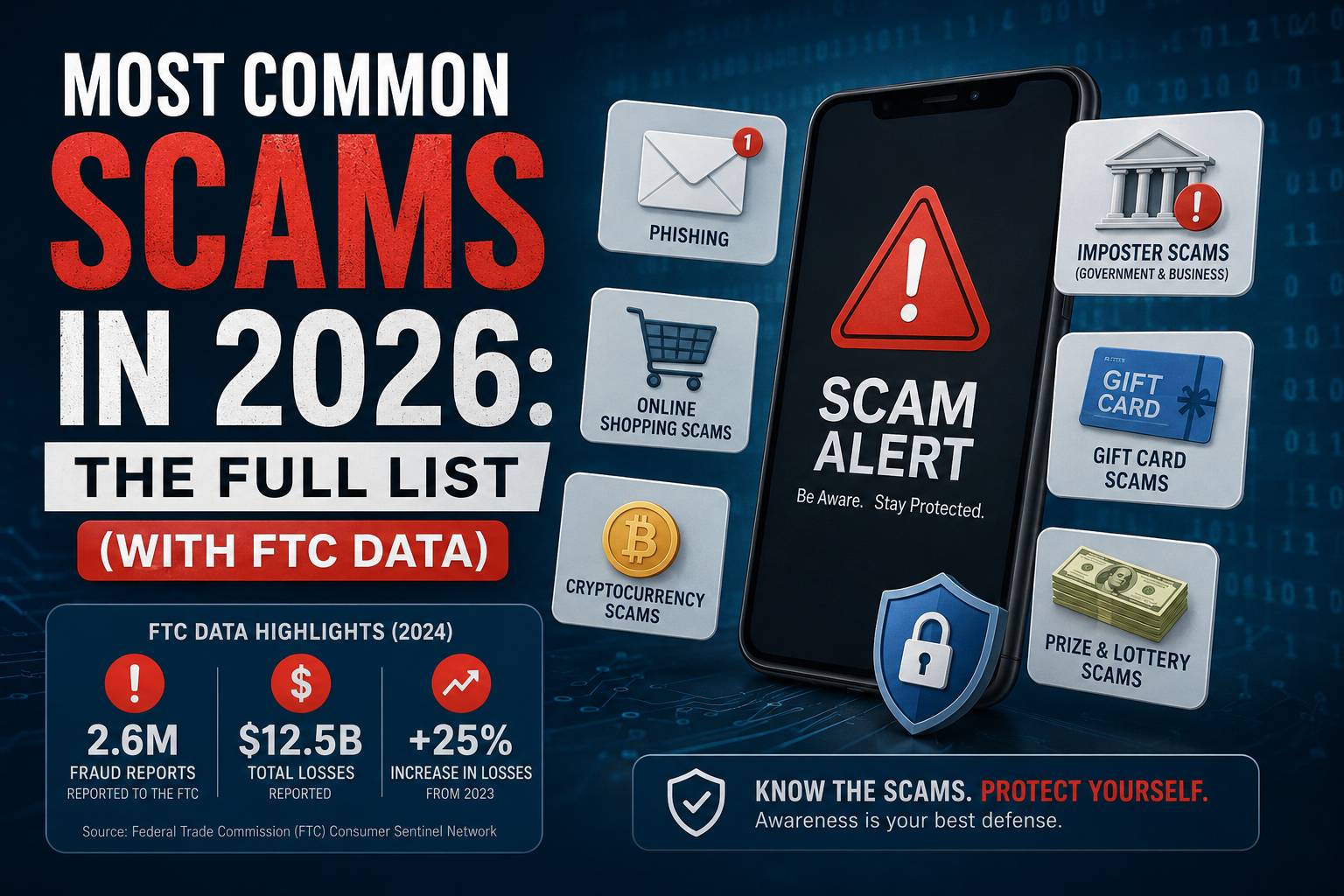
Table of Contents
Scams hit a record in 2025, and 2026 is on track to be worse. Americans reported losing a staggering $15.9 billion to fraud in 2025 — over $3 billion more than the year before, and a 430% jump since 2020. Here are the most common scams circulating right now, what each one looks like, and how to avoid them.
This guide is built on the latest data from the FTC and FBI, and it links out to in-depth breakdowns of the specific scams worth knowing in detail. Bookmark it — the playbook below covers the vast majority of fraud you'll actually encounter this year.
A snapshot of fraud in 2025–2026
- $15.9 billion reported lost to fraud in 2025 — an all-time record.
- 3 million fraud reports filed with the FTC.
- Investment scams drove the biggest losses: roughly $7.9 billion, nearly half of all money lost.
- Imposter scams were the most commonly reported, with record losses of about $3.5 billion.
- Social media was the costliest way scammers reached victims — about $2.1 billion in losses, an eightfold rise since 2020.
- Bank transfers and cryptocurrency accounted for more lost money than all other payment methods combined.
The most common scams in 2026
1. Imposter scams (the most common of all)
Someone pretends to be a person or organization you trust — the IRS, the FBI, your bank, a delivery service, a tech company, even a family member — to pressure you into paying or handing over information. Bank impersonation is now the single most lucrative version. The tell is almost always the same: an urgent problem, a demand to act immediately, and a request for money or personal details.
Two of the most widespread imposter scams right now each deserve their own breakdown:
- The Geek Squad scam email — a fake renewal invoice that tricks you into calling a number and handing over remote access to your computer.
- The EZ Pass / unpaid toll text scam — a fake "unpaid toll" text that steals your card and loads it into the scammer's mobile wallet.
2. Investment & crypto scams (the costliest)
These produce the largest losses by far. Victims are lured with promises of guaranteed, high returns — often in cryptocurrency — through fake trading platforms and fake "advisors." A common and devastating version is the long-con "pig butchering" scam, where a stranger builds a relationship over weeks before steering you onto a fraudulent investment app that shows fake profits until you try to withdraw. If someone you met online is guiding your investment decisions, it's a scam.
3. Online shopping scams
Fake storefronts, counterfeit goods, items that never ship, and deals that are too good to be true. Social commerce has supercharged this category — a viral video can send thousands of buyers to a seller who vanishes after collecting payments. See our full breakdown of whether TikTok Shop is a scam for how to tell a legitimate seller from a trap.
4. Phishing & smishing (text and email scams)
Fake messages designed to steal logins, card data, or install malware. Texts ("smishing") are especially effective because people trust and react to them fast. Watch for two fast-spreading techniques:
- The fake CAPTCHA (ClickFix) scam — a counterfeit "verify you're human" box that tricks you into running a command that installs malware yourself.
- Toll and package-delivery texts — fake "unpaid toll" or "undelivered package" alerts powered by industrial Chinese phishing kits.
5. Romance scams
Scammers build a fake relationship — most start on social media or dating apps — then invent a crisis that requires money, or casually pivot to "investment advice" that funnels you into a fake platform. Nearly 60% of reported romance-scam losses now begin on social media.
6. Job & "task" scams
One of the fastest-growing categories. You're offered easy remote work or "tasks" that promise pay, then asked to deposit your own money to unlock earnings, or to share bank details. Reports tripled in recent years, with losses jumping from $90 million to over $500 million.
7. AI-powered scams (voice cloning & deepfakes)
The newest accelerant. The FBI tied roughly $893 million in 2025 losses to AI-enabled fraud — including cloned voices in "family in distress" emergency calls and deepfake videos used to sell fake investments. A few seconds of audio is now enough to mimic a loved one's voice. Agree on a family "safe word" to defeat this one.
8. Tech support scams
A pop-up, call, or email warns your device is infected and urges you to call "support," who then requests remote access and payment. Older adults are hit hardest. The Geek Squad scam is a flagship example of this category.
9. Refund & overpayment scams
You're told you're owed a refund, then the scammer "accidentally" sends too much and demands you return the difference in gift cards, wire, or crypto. The refund was never real — the money you send back is your own.
10. Prize, sweepstakes & lottery scams
"You've won!" — but you must pay a fee or taxes upfront to claim it. Legitimate prizes never require an advance payment.
11. Family emergency / grandparent scams
A panicked call or text claims a loved one is in jail, in an accident, or in trouble and needs money now. AI voice cloning has made these frighteningly convincing — which is exactly why the safe-word trick matters.
What's driving the 2026 surge
- Social media as the #1 entry point. Nearly a third of reported scam losses now start on a social platform; Facebook alone accounts for more losses than text and email combined.
- AI lowering the barrier. Voice cloning, deepfakes, and AI-written phishing make scams cheaper, faster, and more believable.
- Phishing-as-a-service. Off-the-shelf kits sold on Telegram let low-skill criminals run industrial-scale text scams.
- Irreversible payments. Scammers increasingly push crypto and bank transfers precisely because that money is hard to claw back.
How to protect yourself from any scam
- Treat urgency as a red flag. Pressure to act "right now" is the universal signature of fraud. Slow down.
- Verify independently. Don't use the number or link a message gives you. Contact the company or person through a channel you already trust.
- Never pay with gift cards, wire, or crypto to resolve a "problem." No legitimate business or agency demands this.
- Never grant remote access to your device to anyone who contacts you out of the blue.
- Guard one-time codes. No real company needs the verification code your bank texts you.
- Lock down social media. Limit who sees your posts and never take investment guidance from someone you met online.
- Set a family safe word to defeat AI voice-cloning emergency calls.
What to do if you've been scammed
- Contact your bank or card issuer immediately to stop or dispute payments.
- Change passwords and turn on two-factor authentication, starting with email and banking.
- Remove any remote-access software a scammer had you install, and run a malware scan.
- Report it to the FTC at ReportFraud.ftc.gov and, for online crime, the FBI at ic3.gov.
- Watch your accounts closely for weeks afterward.
The bottom line
Almost every scam in 2026 — no matter how new the technology — runs on the same engine: manufactured urgency plus a trusted-sounding identity, pushing you toward an irreversible payment or a harmful click. Recognize that pattern, refuse to be rushed, and verify everything independently, and you'll defeat the overwhelming majority of fraud before it starts.
Frequently asked questions
What is the most common scam in 2026?
Imposter scams — where someone poses as a trusted person, business, bank, or government agency — are the most commonly reported. Investment scams cause the largest financial losses.
How much are people losing to scams?
Americans reported a record $15.9 billion lost to fraud in 2025, based on about 3 million reports to the FTC — up more than $3 billion from the previous year.
What's the fastest-growing scam right now?
AI-powered fraud — voice cloning and deepfakes — and job or "task" scams are growing especially fast, alongside scams that begin on social media.
What's the single best way to avoid scams?
Refuse to be rushed and verify independently. Never act on the contact details a suspicious message provides; reach the company or person through a channel you already trust.
Sources: U.S. Federal Trade Commission (Consumer Sentinel Network, 2024–2026 data releases), FBI Internet Crime Complaint Center (IC3), and AARP fraud reporting.