Medusa Ransomware Gang Email Phishing: How the Attacks Work and How to Stop Them (2026 Guide)
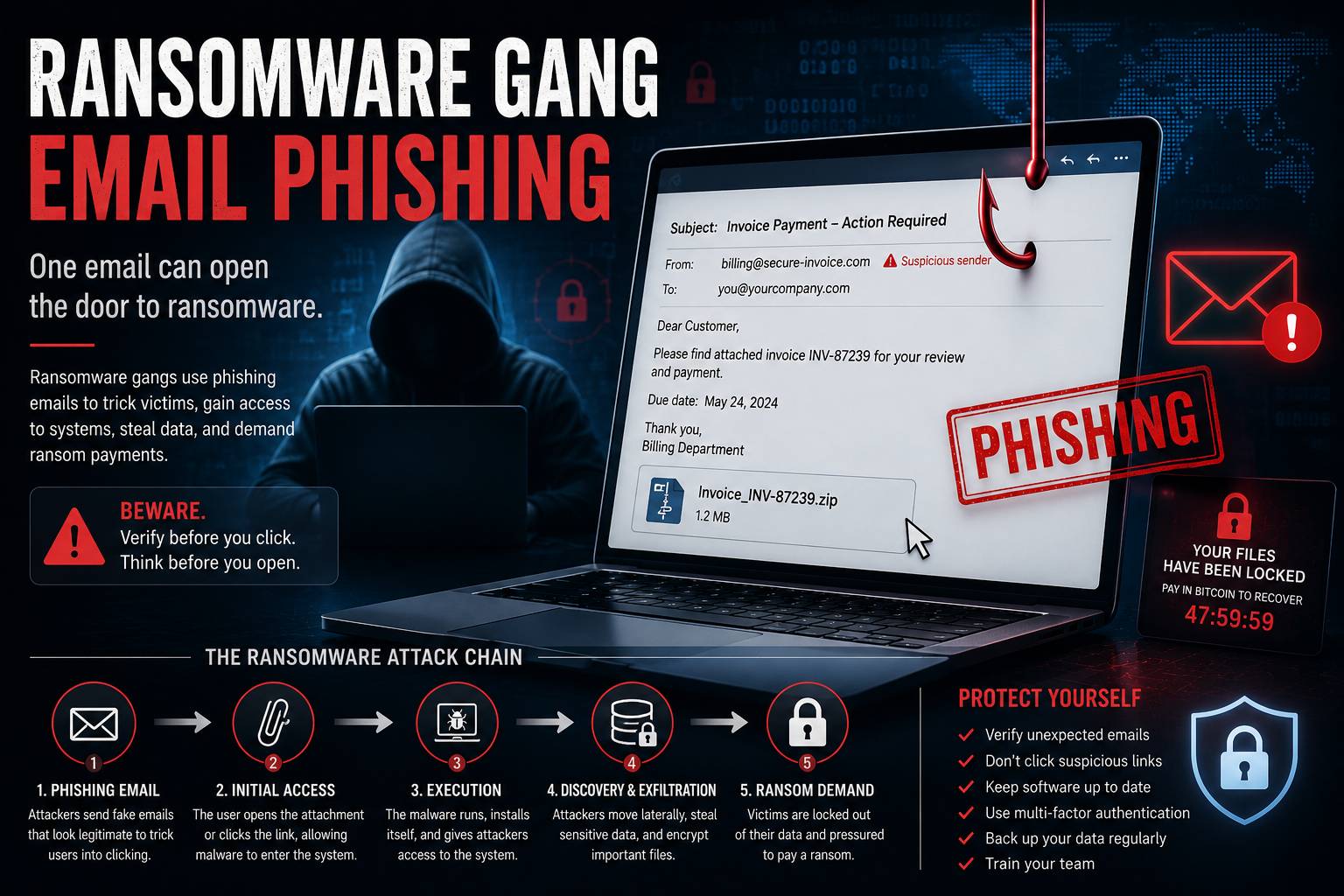
Table of Contents
More than 500 organizations have fallen victim to the Medusa ransomware gang since 2021 — and email phishing remains one of the group's favorite ways in. Hospitals, schools, county governments, and financial institutions have all been hit, with ransom demands ranging from $100,000 to over $8 million.
If you've received a suspicious email and you're wondering whether it could be the first stage of a ransomware attack, this guide explains exactly how Medusa ransomware gang email phishing works, what the emails look like, and the concrete steps that stop these attacks before encryption begins.
Quick check: Received a suspicious link? Scan it for free with ScamSandbox before you click. It takes 10 seconds and could save your entire network.
What Is the Medusa Ransomware Gang?
Medusa is a ransomware-as-a-service (RaaS) operation active since 2021, believed by researchers to be operated out of Russia. The core developers maintain the ransomware and the dark-web "Medusa Blog" leak site, while affiliates carry out the actual intrusions — often starting with phishing emails.
Key facts about the group:
- First observed: June 2021
- Business model: Ransomware-as-a-service with affiliate recruitment
- Extortion style: Double (and sometimes triple) extortion — data is encrypted, stolen, and victims face leak threats plus pressure tactics like contacting their customers
- File marker: Encrypted files get the
.MEDUSAextension, with a ransom note named!!!READ_ME_MEDUSA!!!.txt - Official warning: The FBI, CISA, and MS-ISAC issued joint advisory AA25-071A specifically about Medusa, updated multiple times through 2026
⚠️ Don't confuse it with MedusaLocker. MedusaLocker is an older, separate ransomware strain that spreads through exposed RDP and low-quality mass phishing. The Medusa gang covered here runs far more targeted, sophisticated campaigns.
How Medusa Ransomware Gang Email Phishing Actually Works
Medusa affiliates don't blast generic spam. Their email phishing campaigns follow a deliberate, multi-stage playbook.
Stage 1: Reconnaissance Before the First Email
Before any phishing message is sent, affiliates map the target organization. They identify finance staff, IT administrators, and procurement managers using LinkedIn, company websites, and leaked databases. They learn the company's email format and vendor relationships — which makes the eventual phishing email look legitimate.
Stage 2: The Phishing Email
Medusa-linked phishing emails typically impersonate:
- Delivery notifications (DHL, FedEx, UPS package alerts)
- Invoices and payment requests from known vendors
- Antivirus or security alerts urging the recipient to "verify" credentials
- HR or IT messages (password expiration, mailbox quota, MFA reset)
The goal is almost always credential theft: the link leads to a fake Microsoft 365, VPN, or webmail login page. In some campaigns, attachments deliver loaders that establish remote access directly.
Stage 3: From Stolen Credentials to Full Compromise
Once an employee's credentials are phished, the attack moves fast:
- Initial access using the stolen login (VPN, RDP, or cloud email)
- Living-off-the-land techniques — legitimate tools like PowerShell, RDP, and remote monitoring/management (RMM) software are abused to move laterally without triggering antivirus
- Defense evasion — endpoint protection is disabled, often using vulnerable drivers
- Data exfiltration — sensitive files are stolen before encryption
- Encryption and extortion — files are locked with the
.MEDUSAextension and a countdown begins on the leak site
Microsoft tracks one Medusa-deploying cluster as Storm-1175 and reports that the group can go from initial access to data theft and encryption within a single day. Speed is the defense's enemy here: by the time a phished employee reports the email, the attackers may already be inside.
Phishing Isn't Their Only Door
It's worth noting that Medusa also buys access from initial access brokers (who themselves use phishing and credential stuffing) and exploits unpatched software — including zero-day vulnerabilities such as CVE-2026-23760 (SmarterMail) and CVE-2025-10035 (GoAnywhere MFT). But for most small and mid-sized businesses, the phishing email remains the most likely first contact with this gang.
Real Medusa Attacks That Started With Compromised Access
The victim list shows just how indiscriminate the gang is:
- Toyota Financial Services — hit with an $8 million ransom demand
- Minneapolis Public Schools — student data leaked after refusal to pay
- University of Mississippi Medical Center (March 2026) — the state's largest hospital, home to its only children's hospital and Level I trauma center
- Passaic County, New Jersey (March 2026) — government phone lines and IT systems down, with an $800,000 ransom demand
- McDonough County — another recent ransomware incident affecting government operations and citizen data
- Hundreds of SMBs — the gang heavily targets small and medium businesses where security teams are thin
In early 2026, researchers at Symantec even observed operators linked to North Korea's Lazarus group deploying Medusa ransomware against U.S. healthcare organizations — a sign of how widely this ransomware is now distributed.
How to Recognize a Medusa-Style Phishing Email
Train yourself and your team to spot these red flags:
- ✅ Urgency + credentials — any email that pressures you to log in "immediately" to avoid a consequence
- ✅ Lookalike domains —
micros0ft-secure.com,dhl-track-delivery.net, or your own company name with a hyphen added - ✅ Unexpected invoices or delivery notices — especially if you didn't order anything
- ✅ Login pages reached via email links — legitimate services rarely require this; type the URL yourself instead
- ✅ Generic greetings with specific demands — "Dear user, your mailbox will be deleted in 24 hours"
The single most effective habit: never enter credentials on a page you reached by clicking an email link. And before clicking any suspicious link, paste it into a URL scanner like ScamSandbox to see what's really behind it — safely, without exposing your machine.
How to Protect Your Organization From Medusa Ransomware
The FBI/CISA advisory on Medusa recommends a layered defense. Here are the priorities, in order of impact:
1. Phishing-Resistant MFA Everywhere
Enable multi-factor authentication on email, VPN, and all remote access — prioritizing webmail and VPN gateways. Phished passwords are useless to Medusa affiliates if they can't pass the second factor. Where possible, use phishing-resistant methods (FIDO2 keys, passkeys) rather than SMS codes.
2. Patch Fast — Especially Internet-Facing Systems
Medusa weaponizes new vulnerabilities within days, sometimes before public disclosure. File-transfer tools, mail servers, VPN appliances, and firewalls should be on an emergency patching track.
3. Lock Down Remote Access Tools
Audit and restrict RMM software (AnyDesk, ConnectWise, etc.). Medusa abuses these legitimate tools for persistence and lateral movement. If you don't use a tool, block it.
4. Segment Your Network
Flat networks let attackers go from one phished laptop to the domain controller in hours. Segmentation limits the blast radius.
5. Offline, Tested Backups
Maintain backups that ransomware can't reach — offline or immutable — and actually test the restore process. Backups are the difference between a bad week and an existential crisis.
6. Phishing Awareness and Reporting Culture
Since email phishing is a primary entry vector, employees are your sensor network. Make reporting suspicious emails fast and blame-free. A reported phish within minutes can stop an intrusion that would otherwise become a full encryption event within 24 hours.
What to Do If You Clicked a Suspicious Link
If you suspect you've clicked a malicious link that could be part of a Medusa phishing campaign, follow our detailed step-by-step guide on what to do after clicking a phishing link:
- Disconnect the machine from the network (Wi-Fi off, cable out)
- Change your password immediately from a different, clean device — and any other account using the same password
- Alert your IT/security team — speed matters more than embarrassment
- Check for MFA prompts you didn't initiate and deny them
- Scan the URL with ScamSandbox to confirm whether it was a credential-harvesting page, and preserve the email for analysis
If files are already encrypted with the .MEDUSA extension: do not delete the ransom note, isolate affected systems, and contact law enforcement (FBI/IC3 in the US, or your national CERT). The FBI advises against paying — payment funds the next wave of attacks and offers no guarantee of recovery.
The Role of AI in Modern Ransomware Operations
Modern ransomware groups like Medusa are increasingly leveraging artificial intelligence tools to enhance their operations. Malicious AI tools like WormGPT are being used by cybercriminals to:
- Generate more convincing phishing emails that bypass traditional filters
- Create polymorphic malware that evades detection
- Automate reconnaissance and target selection
- Scale social engineering attacks across multiple languages and cultures
Understanding how AI is weaponized by threat actors helps defenders prepare for the evolving threat landscape that groups like Medusa operate in.
FAQ: Medusa Ransomware Gang Email Phishing
Does the Medusa ransomware gang really use email phishing?
Yes. Phishing for credentials is one of Medusa's primary initial access techniques, alongside buying access from brokers and exploiting unpatched vulnerabilities. The FBI/CISA joint advisory explicitly lists phishing campaigns as a Medusa entry vector.
What do Medusa phishing emails look like?
They commonly impersonate delivery notices, invoices, antivirus alerts, or internal IT messages, and link to fake login pages designed to steal employee credentials.
How fast does a Medusa attack happen after a successful phish?
In documented cases, the gang has gone from initial access to data exfiltration and encryption within one day.
Is Medusa the same as MedusaLocker?
No. They are separate operations. MedusaLocker dates to 2019 and uses noisier, lower-quality tactics. The Medusa gang (active since 2021) runs the high-profile RaaS operation behind attacks on Toyota Financial Services and U.S. hospitals.
Can ransom emails from Medusa be phishing too?
The email addresses Medusa uses for ransom negotiation are separate from its phishing infrastructure — but scammers do send fake "you've been hacked by Medusa" extortion emails to companies that were never breached. Verify before panicking, and scan any links with a tool like ScamSandbox.
Bottom Line
The Medusa ransomware gang has turned email phishing into a conveyor belt: one stolen password can put an entire organization on a dark-web countdown timer within 24 hours. The defenses are unglamorous but proven — phishing-resistant MFA, fast patching, segmented networks, offline backups, and a workforce that checks before it clicks.
Before you click any suspicious link, scan it for free at ScamSandbox.com. Ten seconds of caution beats weeks of incident response.
Sources: FBI/CISA/MS-ISAC Joint Advisory AA25-071A, Microsoft Threat Intelligence (Storm-1175), Symantec Threat Hunter Team, Darktrace SOC analysis, Recorded Future News.